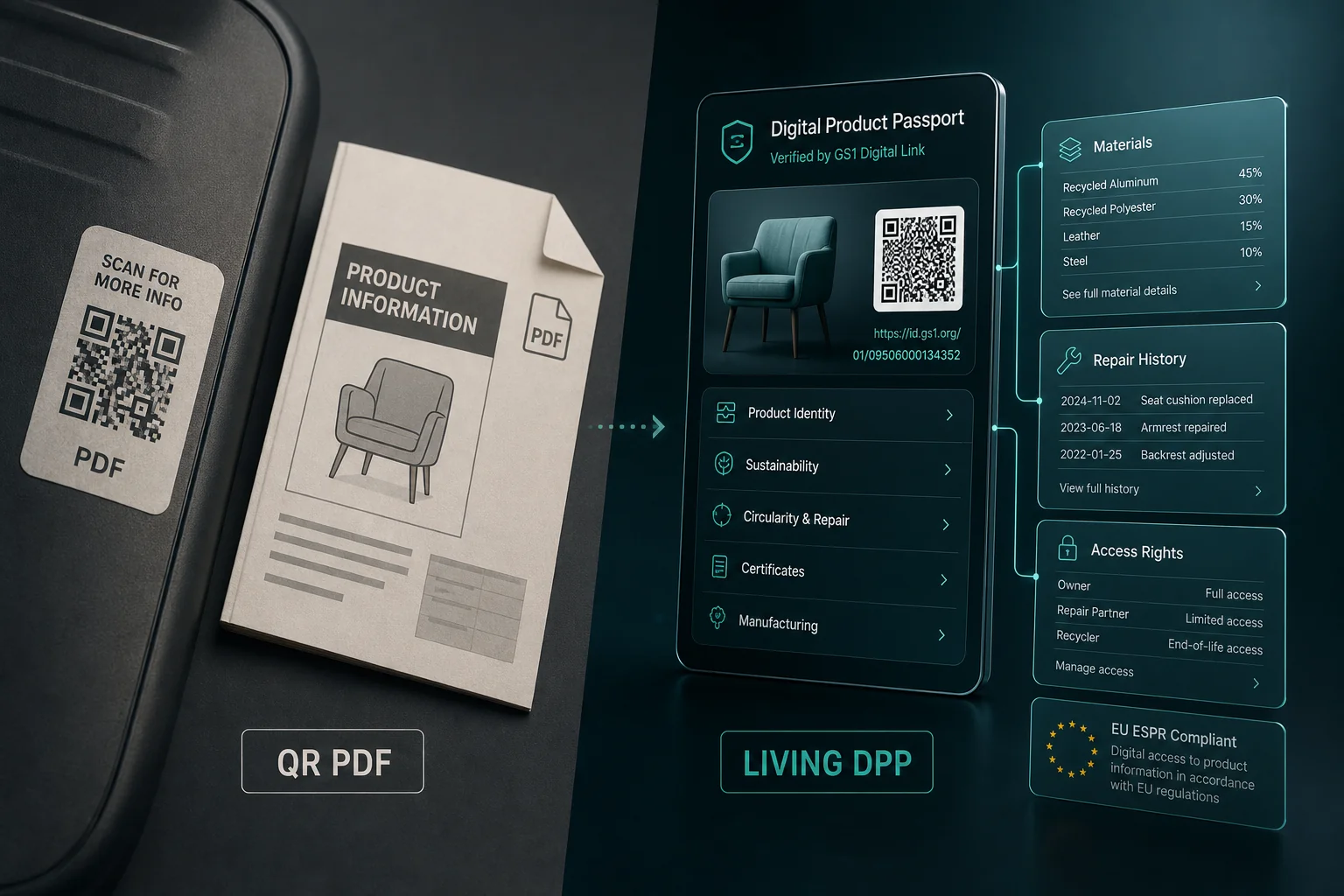
Since the Digital Product Passport (DPP) became a European hot topic, confusion has spread: putting a QR code on packaging and showing a web page or PDF does not constitute a Digital Product Passport. ESPR and the Batteries Regulation require far more than a scannable carrier. This article explains how to tell a fake “marketing DPP” from a real compliant passport — and why the difference matters for compliance, repair and circularity.
Key takeaways
- •A QR code is only a carrier: what matters is what it resolves and how data is governed.
- •A real DPP exposes structured (machine-readable) data, not just a marketing PDF.
- •Differentiated access rights (public / operator / authority / repairer) are a key criterion.
- •GS1 Digital Link (or equivalent resolvable ID) and persistence over time are essential.
- •Without post-sale updates (repairs, warranties), the passport dies at delivery.
- •“DPP-ready” greenwashing with a plain QR creates regulatory and reputational risk.
The myth: “We added a QR, so we have a DPP”
The QR code has become the visible symbol of the DPP. Fair enough: EU rules foresee a data carrier to access the passport. But the carrier is not the passport.
Many “DPP-ready” projects today stop at: a QR on packaging, a marketing URL, a PDF sheet or a product landing page. Useful for storytelling — insufficient for ESPR, the Batteries Regulation and European interoperability.
Result: teams believe they are “ready for 2027” while they still lack a data model, access rights, update capability and a standardised resolvable identifier.
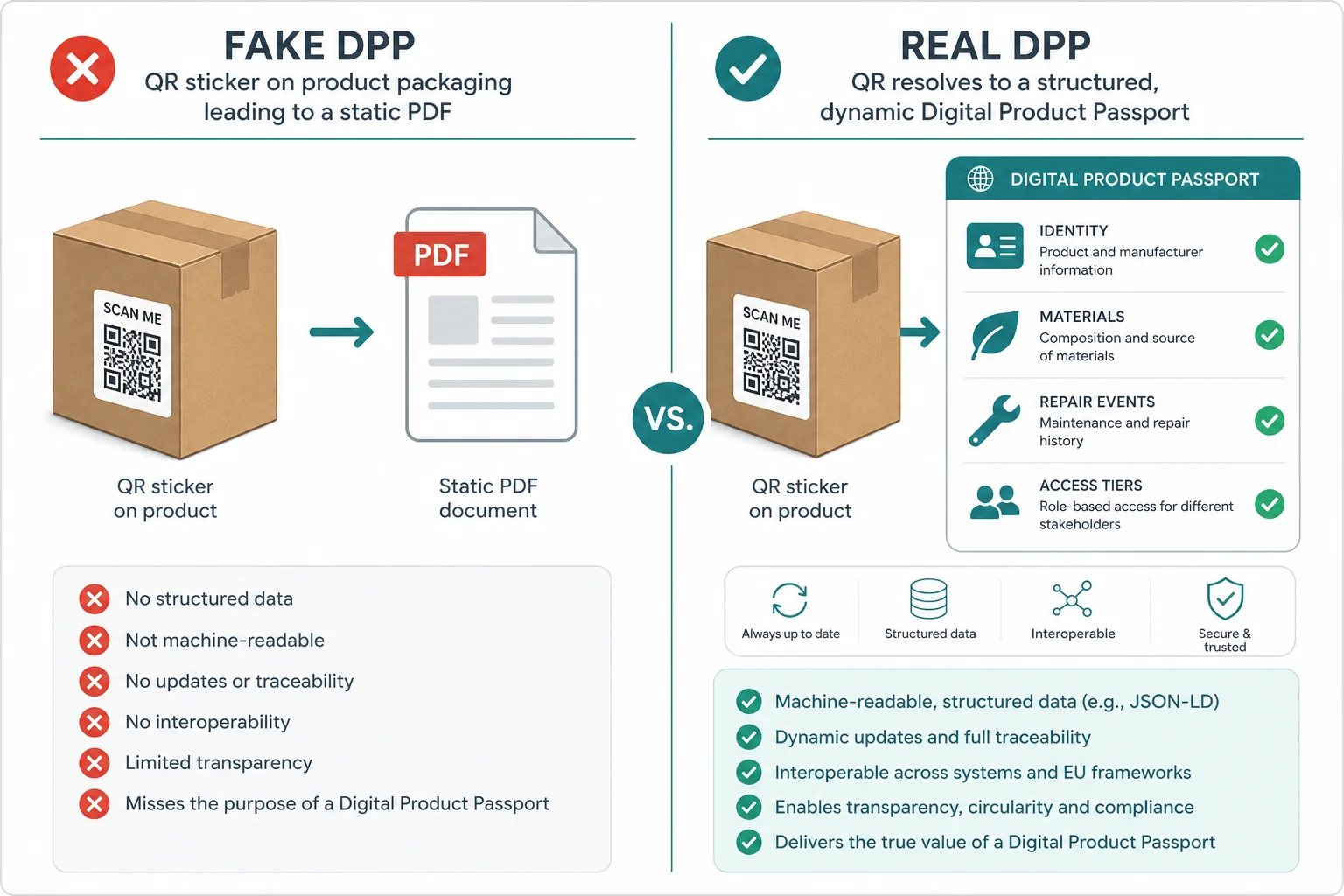
What a Digital Product Passport really requires
A real DPP is a product information system: identity, regulatory attributes, lifecycle history, and access rules by role (consumer, economic operator, authority, repair or recycling actor).
In practice, five pillars separate real from fake:
- ✓Durable identity (GTIN / serial / batch) and reliable web resolution (e.g. GS1 Digital Link)
- ✓Structured, exchangeable data (JSON-LD, RDF, API) — not only a PDF
- ✓Differentiated access rights for audiences required by the texts
- ✓Persistence and governance: who publishes, who updates, who audits
- ✓Post-sale events: warranties, repairs, parts, end of life
Fake DPP vs real DPP: a reading grid
Use this grid to audit a solution, a vendor or an internal project.
| Criterion | Marketing QR / PDF | Real DPP (ESPR / batteries) |
|---|---|---|
| Displayed content | Web page or static PDF | Structured data + human view |
| Identifier | Often opaque custom URL | Standardised resolvable ID (e.g. GS1) |
| Access rights | All public or nothing | Access tiers (public / pro / authority) |
| Updates | Rare or manual | Traceable lifecycle events |
| Interoperability | Proprietary / silo | Open standards, machine-readable exports |
| Compliance evidence | Storytelling | Completeness, auditability, EU registry |
| After-sales value | Low | After-sales, repair, second life |
Checklist: 8 questions to recognise a real passport
Before buying a solution or validating a pilot, ask these questions — to your vendor and your internal teams.
- ✓If I scan outside a marketing context, does the URL resolve a standard product identifier?
- ✓Can I get data as JSON-LD / API, not only HTML or PDF?
- ✓Are there distinct access profiles (consumer, repairer, authority)?
- ✓Who is responsible for updates after placing on the market?
- ✓Can a repair be written back into the passport?
- ✓Do data survive if I change vendor (portability)?
- ✓Does the model cover my category (e.g. Annex XIII for batteries)?
- ✓Is there an audit trail (who published what, when)?
Why a fake DPP is risky
From a regulatory standpoint, presenting a marketing QR as “DPP compliant” while required data is missing creates a compliance gap once obligations start (batteries on 18 February 2027, then other categories via ESPR delegated acts).
On the commercial side, consumers and B2B buyers are more demanding: a decorative PDF no longer convinces compliance teams, nor repair or recycling partners.
On the technical side, rebuilding a real data model later costs more than starting right: the bottleneck is almost never the QR — it is supplier data and governance.
The decisive criterion: a living passport, not a dead label
The circular economy promised by ESPR assumes the product keeps “speaking” after sale. Warranties, failures, interventions, spare parts: without writing these events, the DPP remains a frozen ID photo.
That is why Verisav natively links DPP and after-sales. The same identifier serves consumer, manufacturer and repairer: the passport grows across the lifecycle.
A QR that only opens a brochure cannot play that role — even if it looks beautiful in print.
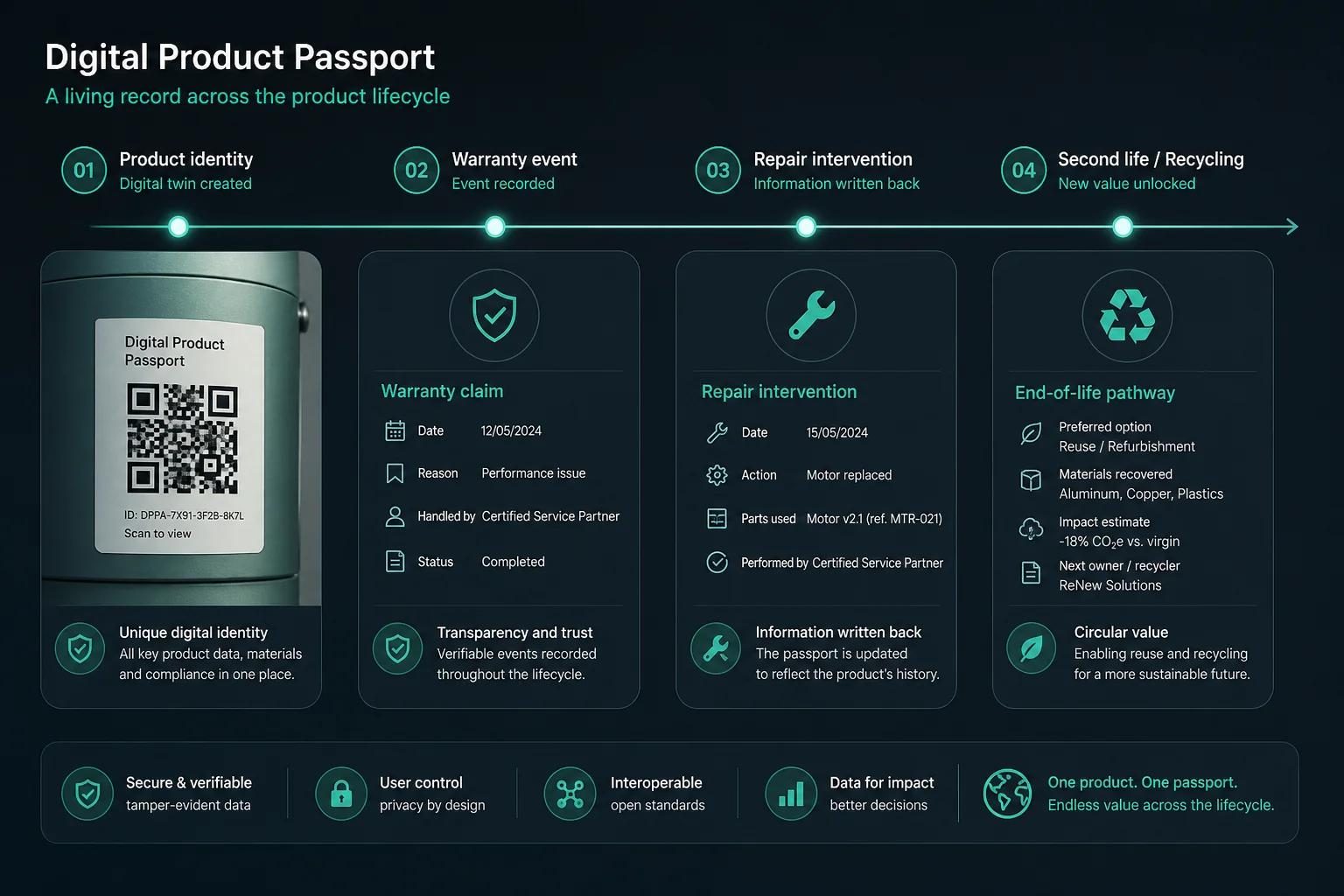
How Verisav structures a real DPP
Verisav is a French platform that treats the DPP as product + after-sales infrastructure: passport creation and publication, GS1 Digital Link, machine-readable exports, access rights, and linkage of post-sale events.
Open RDF/OWL vocabularies (LOV / W3ID), free preparation tools, sector landings and operational guides: the goal is not a cosmetic QR, but a usable, auditable passport.
If you only have “a QR” today, that is not a failure — it is a starting point. Next is industrialising the data and the life of the passport.
Go further
On Verisav
Move from a marketing QR to a real DPP
Audit your current passport, publish a structured pilot and connect after-sales — with Verisav.