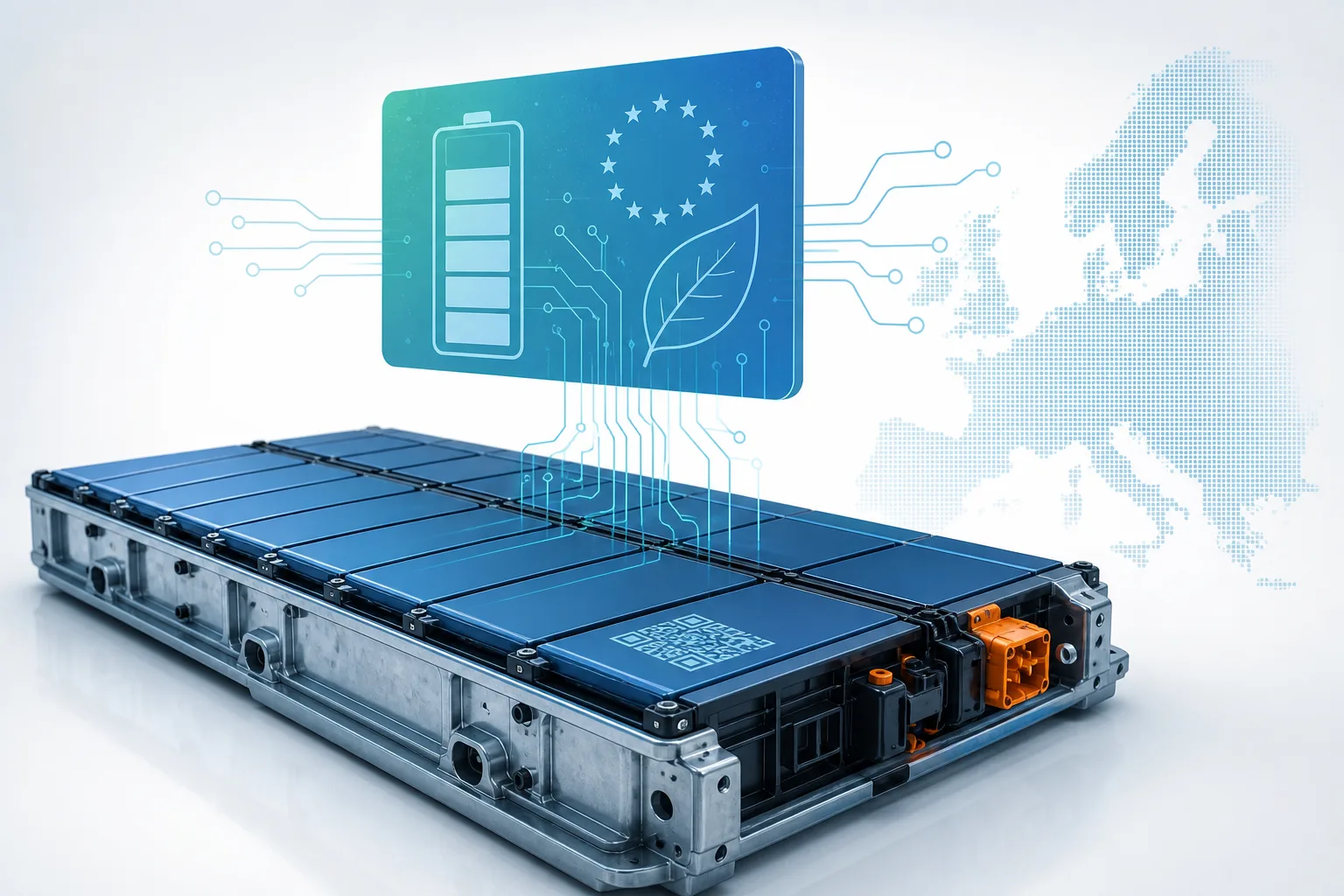
EU Battery Passport — the first mandatory DPP from 18 February 2027. The European Union battery passport is the first large-scale, concrete application of the digital product passport in an industrial context. Introduced by Regulation (EU) 2023/1542 on batteries and waste batteries, it will make mandatory, from 18 February 2027, a unique and verifiable digital identifier for every electric vehicle (EV) battery, every light means of transport (LMT) battery — the batteries powering e-bikes, e-scooters, mopeds and similar vehicles — and every industrial battery with a capacity greater than 2 kWh placed on the European market. This passport, accessible via a QR code affixed to the battery, exposes a subset of its data (general information, material composition, capacity, carbon footprint, recycled content, safety information) to the general public, and a further subset (confidential data, detailed chemistry, usage history) only to authorised parties: market surveillance authorities, repair operators, remanufacturers and recyclers. The common technical framework — data carriers, EU registry, APIs and security schemes — builds on Regulation (EU) 2024/1781 on the ecodesign of sustainable products (ESPR) and on CEN/CENELEC JTC 24 standards. For manufacturers, importers and economic operators, the 18 February 2027 deadline is close: this is no longer a project, but an operational programme touching product engineering, supply chain, after-sales service and information systems. This article summarises — without hype and based on source verification — what to know, what to prepare, and where to consult the official texts and scientific literature.
Key takeaways
- •Legal basis: Regulation (EU) 2023/1542 on batteries — the battery passport is distinct from the generic ESPR DPP, but relies on its technical framework.
- •Application date: 18 February 2027 for EV, LMT and industrial batteries above 2 kWh placed on the market on or after that date.
- •Scope: SLI (starting, lighting, ignition) batteries are not subject to Article 77 but must still carry a QR code with general information.
- •Access: physical QR code + unique product identifier; public data for everyone, restricted data for authorities and authorised operators.
- •Content: Annex XIII data — composition, carbon footprint, recycled content, performance, safety, supply chain, repairability.
- •Responsible party: the economic operator placing the finished battery on the market (manufacturer, importer or distributor acting as such).
- •Technical framework: CEN/CENELEC JTC 24 standards (EN 18216–18223, OJEU 2026/1736) and the EU DPP registry operational since 20 July 2026 (IR 2026/1778 applicable from 6 August 2026).
- •Caveat: due diligence (Article 48), carbon footprint and recycled content follow their own schedule — verify secondary acts and guidelines before every milestone.
What is the battery passport?
The battery passport is a structured, unique, persistent and queryable digital record, unambiguously associated with a physical battery by a unique product identifier. It is not a mere datasheet: it is a regulatory compliance building block, a supply-chain traceability infrastructure, and a circularity tool for repair, remanufacturing (second life) and recycling.
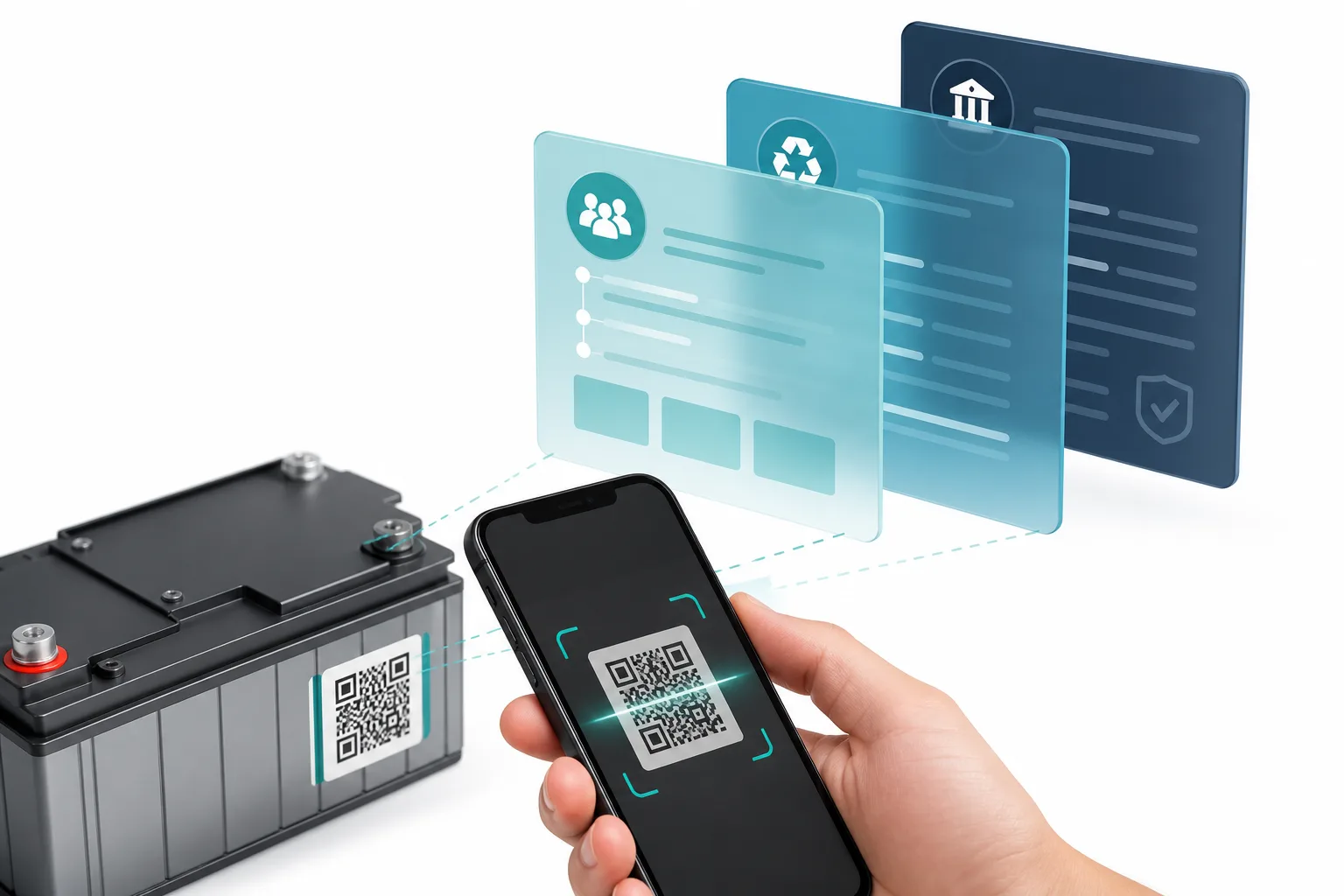
Concretely, a battery placed on the market after 18 February 2027 must carry a data carrier (typically a QR code) that, once read, redirects the user — consumer, inspector, repairer, recycler — to its digital passport. Depending on the identity and rights of the person scanning, the data displayed will be more or less complete.
The logic introduced by Regulation (EU) 2023/1542 is twofold. On the one hand, it strengthens the responsibility of placing on the market: the economic operator commercialising the battery becomes accountable for the truthfulness, availability and updating of the passport. On the other hand, it aims to build an open infrastructure enabling the circular economy of batteries: without a reliable passport, it is impossible to remanufacture, reuse or recycle cells efficiently.
The battery passport is the first mandatory DPP deployed at scale in the EU. As such, it acts as the testbed for the entire DPP framework foreseen by the ESPR (Regulation 2024/1781). The infrastructure it requires — European registry, CEN/CENELEC standards, authentication chains — will then serve textile, electronics, steel and other future DPPs. For Verisav, this is also the flagship use case shaping our after-sales + passport platform.
Legal basis and articulation with the ESPR
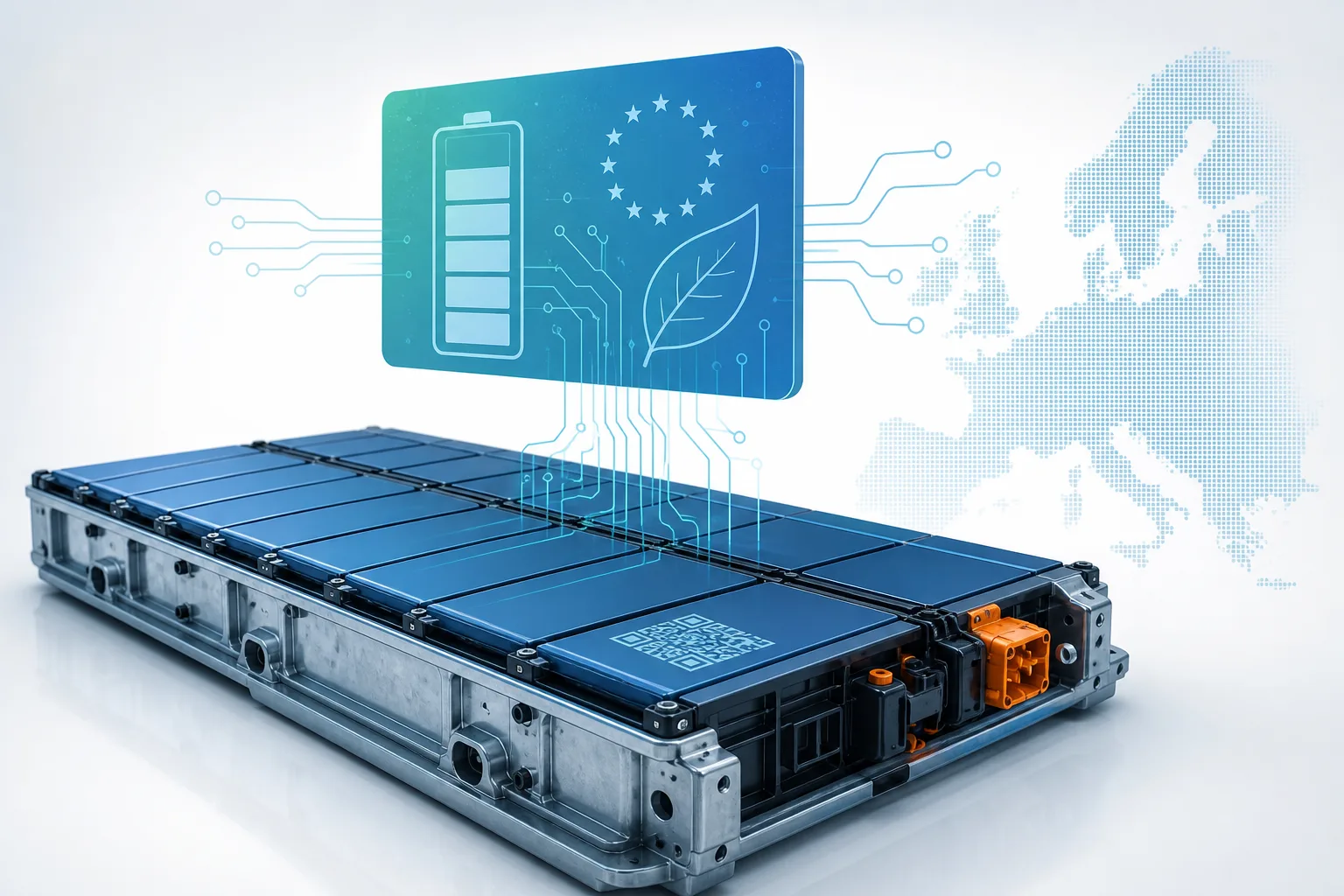
The main legal basis of the battery passport is Regulation (EU) 2023/1542 of the European Parliament and of the Council of 12 July 2023 on batteries and waste batteries, in particular its Article 77 (battery passport) and Annex XIII (information and data contained in the battery passport). This regulation replaces Directive 2006/66/EC and imposes a harmonised set of rules applicable in all 27 Member States, with no need for national transposition.
The battery passport is not an ESPR delegated act: it stems from a specific sectoral regulation adopted before the ESPR itself was published. However, Regulation (EU) 2024/1781 on the ecodesign of sustainable products (ESPR), applicable since 18 July 2024, defines the horizontal DPP framework — European registry, generic technical specifications, access architectures — with which the battery passport is progressively aligned, notably through CEN/CENELEC JTC 24 standards.
A frequently misunderstood point: Article 48 due diligence (responsible sourcing of cobalt, natural lithium, nickel and natural graphite) and certain obligations linked to carbon footprint and recycled content follow their own schedule, distinct from the 18 February 2027 date. According to recent Commission clarifications, application of Article 48 has been postponed in time (indications converging toward August 2027 for the concerned actors, subject to the publication of guidelines and calculation methods). It is prudent to treat these deadlines as indicative and to verify every secondary act before any contractual commitment.
Regarding standardisation, the joint CEN/CENELEC Technical Committee JTC 24 'Digital Product Passport' is publishing a series of EN standards (EN 18216 to EN 18223) that provide the common technical foundation: unique identifiers, data carriers, access APIs, security, interoperability and data governance. Some of these standards have been published since mid-2026; others (notably prEN 18239 and prEN 18246) are still in draft.
| Instrument | Role | Status |
|---|---|---|
| Regulation (EU) 2023/1542 | Legal basis of the battery passport (Art. 77, Annex XIII) | In force — applies from 18 February 2027 |
| Regulation (EU) 2024/1781 (ESPR) | Horizontal DPP framework (EU registry, common specifications) | In force since 18 July 2024 |
| CEN/CENELEC JTC 24 standards | Technical specifications: identifiers, APIs, security, carriers | Staggered publication 2025-2027 |
| Commission guidelines (Art. 48) | Supply-chain due diligence for critical raw materials | Expected before deadline — verify publication |
Scope: which batteries are covered?
Article 77 of Regulation 2023/1542 states that the battery passport is mandatory for three categories: electric vehicle (EV) batteries, light means of transport (LMT) batteries — namely batteries for pedelecs, e-scooters, self-balancing devices, mopeds and equivalent limited-power vehicles — and industrial batteries with a capacity greater than 2 kWh, including stationary storage batteries.
SLI batteries (Starting, Lighting, Ignition — classic 12 V automotive lead-acid or equivalent starter batteries) are, as a rule, not subject to the Article 77 passport obligation. They remain nonetheless bound, under other provisions of the regulation, to a QR code exposing general information: manufacturer identity, capacity, hazardous substances, recycling information. Portable batteries for the general public (alkaline cells, smartphone batteries, consumer power-tool packs) follow a distinct labelling and information regime, not covered by the Article 77 battery passport.
The trigger is placing on the EU market: any EV, LMT or industrial battery > 2 kWh placed on the market on or after 18 February 2027 must have an active passport at the moment of commercialisation. Batteries placed on the market before that date are not retroactively subject to the requirement, but their second life (remanufacturing, reuse) will have to interoperate with the post-2027 regime.
It is essential to understand that the passport is bound to the physical unit (unique identifier per battery or pack), not to a model. Two identical batteries coming off the same production line will each have their own passport, carrying their own history (factory tests, owner, redeployments, repairs).
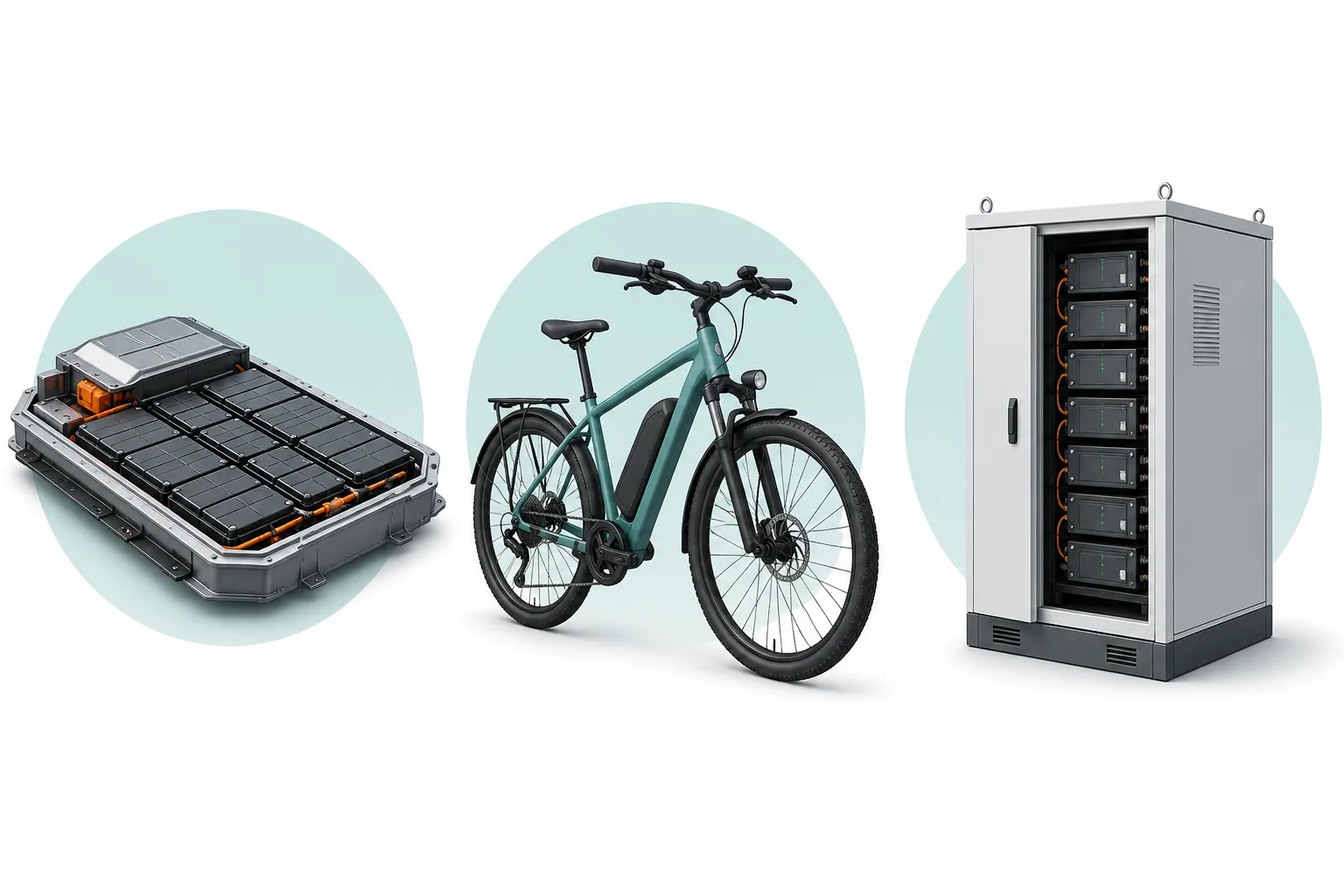
| Category | Art. 77 passport mandatory | Additional requirements |
|---|---|---|
| EV batteries (cars, vans, buses) | Yes | Full Annex XIII + due diligence |
| LMT batteries (e-bikes, e-scooters, mopeds) | Yes | Adapted Annex XIII + performance and durability |
| Industrial batteries > 2 kWh (stationary storage, machinery) | Yes | Annex XIII + installation information |
| SLI batteries (classic automotive starter) | No (Art. 77) | General-information QR code + labelling |
| Portable consumer batteries | No | Labelling and information under separate regime |
Regulatory timeline and 18 February 2027
The battery passport fits into a regulatory trajectory extending from 2023 (adoption of Regulation 2023/1542) to the end of the decade. The pivot date is 18 February 2027, but several prior and subsequent milestones shape operational implementation.
| Date | Event |
|---|---|
| 12 July 2023 | Adoption of Regulation (EU) 2023/1542 on batteries and waste batteries |
| 18 February 2024 | Start of application of Regulation 2023/1542 |
| 18 July 2024 | Regulation (EU) 2024/1781 (ESPR) enters into application |
| 2025-2026 | Staggered publication of CEN/CENELEC JTC 24 standards (EN 18216 to 18223) |
| 26 July 2026 | Deadline for Commission guidelines on battery due diligence (Art. 48) |
| 20 July 2026 | EU DPP registry goes live (production + test environment) |
| 6 August 2026 | Implementing Regulation (EU) 2026/1778 enters into force |
| 18 February 2027 | Mandatory application of the battery passport (Article 77) |
| August 2027 (indicative) | Entry into application of Article 48 on due diligence (indicative postponement) |
| 2028-2030 | Progressive alignment of the battery passport on the horizontal DPP infrastructure |

Mandatory data (Annex XIII of Regulation 2023/1542)
Annex XIII of Regulation 2023/1542 lists in detail the information and data to be contained in the battery passport. These data cover product identity, composition, performance, durability, environmental footprint, compliance and history. They are split between data publicly accessible, data reserved for authorities and notified bodies, and data reserved for authorised operators (repairers, remanufacturers, recyclers).
Some requirements are not immediate on 18 February 2027: the Product Carbon Footprint (PCF) follows a harmonised calculation method whose publication is gradual, and recycled-content thresholds for cobalt, lithium, nickel and lead only apply from later dates (2031 for the initial declaration of recycled content, 2036 for minimum thresholds, per the relevant articles of the regulation). The passport must nonetheless be capable of hosting these fields from its go-live.
The table below synthesises the main information domains required. It does not replace reading Annex XIII, which must be consulted in the official EUR-Lex text.
| Domain | Examples of data | Public / restricted |
|---|---|---|
| Identity and manufacturer | Model, serial number, responsible economic operator, date and place of manufacture | Public |
| Material composition | Battery chemistry, active materials, hazardous substances (SVHC) | Public (aggregated) / Restricted (detailed) |
| Performance and durability | Nominal capacity, energy, power, cycles, internal resistance, expected degradation | Public (indicators) / Restricted (raw data) |
| Carbon footprint | Declared PCF, carbon performance class (per upcoming harmonised PEF method) | Public |
| Recycled content | Share of recycled cobalt, lithium, nickel and lead (applicable from 2031/2036 depending on thresholds) | Public |
| Safety | Safety data sheets, known incidents, transport and storage precautions | Public / Restricted depending on nature |
| Supply chain | Origin of critical materials, due diligence report (Art. 48) | Restricted (authorities and audits) |
| Repairability and dismantling | Dismantling instructions, spare parts, service procedures | Restricted (authorised operators) |
| Usage history | Cumulative cycles, charging events, ownership changes, service events | Restricted (operators and owner) |
| End of life | Collection instructions, recycling channel, material sorting | Public |
Access rights and confidentiality levels
Regulation 2023/1542 introduces a cardinal principle: not all passport data are public. The general public accesses a subset of useful information (identity, safety, carbon footprint, end-of-life instructions), while sensitive data (detailed chemistry, fine-grained history, commercial data) are reserved for authorised parties. This gradation protects industrial interests while ensuring transparency where necessary.
Market surveillance authorities have extended access rights, in particular to verify compliance, monitor due diligence and open enforcement proceedings. Notified bodies and auditors may, within their scope, consult the relevant data. Repair, remanufacturing and recycling operators access the information they need to perform their trade (dismantling instructions, usage history, cell chemistry) — a crucial point for the circular economy.
Technically, access-rights management relies on authentication, delegation and audit mechanisms. CEN/CENELEC JTC 24 standards specify the authentication schemes and APIs to use. Verisav implements these mechanisms in its platform, building on the open vocabularies published at w3id.org/verisav/dpp.
| Actor | Type of access | Examples of data |
|---|---|---|
| Consumer / general public | Public read access via QR code | Product identity, safety, carbon footprint, end of life |
| Market surveillance authorities | Extended read + audit | Supply chain, due diligence, compliance |
| Notified bodies | Targeted read | Compliance and testing data |
| Approved repairers and remanufacturers | Read + history write | Dismantling instructions, usage history, service events |
| Recyclers | Technical end-of-life read | Composition, chemistry, channels |
| Battery owner | Personal read access | History of one's own equipment |
Data carriers: QR code and unique identifier
Regulation 2023/1542 requires every battery subject to the passport to carry a data carrier readable by usual means. In practice, this is a QR code (typically compliant with GS1 Digital Link specifications) marked durably on the battery itself, or on its primary packaging when direct marking is technically impossible. Marking durability is essential: the QR code must remain readable throughout the life cycle, including after several years of use in industrial or automotive environments.
The QR code encodes a unique product identifier which, once resolved through a compliant resolution infrastructure (EU registry or approved third-party service), redirects to the digital passport itself. The unique identifier is not a simple internal serial number: it is structured according to the technical specifications adopted (CEN/CENELEC JTC 24 standards) and referenced in the EU DPP registry, enabling authorities — including at customs — to verify automatically the presence and validity of a passport before placing on the market.
Other carriers (NFC, passive RFID, direct part marking by laser) may be used to complement the QR code, but the QR remains the reference carrier mandatory for reading by the general public. Manufacturers must anticipate the physical placement of the marking as early as design (design for compliance), to avoid late re-tooling costs.
Roles of economic operators and compliance checklist
Regulation 2023/1542 designates the 'economic operator' placing the finished battery on the EU market as responsible for the passport. Depending on industrial setups, this can be the original manufacturer (OEM), an importer (for batteries manufactured outside the EU), or a distributor acting as market placer (repackaging, private label). This designation is strict: it entails legal liability for the truthfulness of data, an obligation to keep them up to date, and exposure to penalties in case of non-compliance.
Subcontractors (cell suppliers, assemblers) contribute data but do not bear final responsibility: it is the market placer who must contractually ensure the flow of information. For an importer, this means requiring from its non-EU supplier access to Annex XIII data and a guarantee of their truthfulness — a sensitive point in Asian supply chains.
Verisav supports economic operators in the articulation between battery passport and after-sales service: every service event (diagnosis, repair, cell replacement, remanufacturing) becomes a traceable and signed entry of the passport. This operational continuity is what distinguishes a 'paper' passport (compliant but dead) from a 'living' passport genuinely useful to repairers, recyclers and successive owners.
- ✓Identify the responsible economic operator for each battery reference placed on the EU market (manufacturer, importer or distributor).
- ✓Map Annex XIII data: where are they today (PLM, ERP, MES, LIMS, subcontractors) and how to feed them upstream.
- ✓Contractually secure data supply from non-EU cells and subassemblies (supplier agreements, audits).
- ✓Choose a DPP platform compliant with CEN/CENELEC JTC 24 standards and interoperable with the EU registry.
- ✓Plan the physical QR code marking (durability, placement, size, contrast) from design or as an industrial retrofit.
- ✓Define the access policy: which data are public, restricted, reserved for authorities.
- ✓Set up data governance: roles, responsibilities, updates, versioning, logging.
- ✓Prepare synchronisation with the EU DPP registry and automated customs controls.
- ✓Anticipate subsidiary milestones: Art. 48 due diligence, carbon footprint (PCF), recycled content, durability scores.
- ✓Train after-sales, repair and recycling teams to read, write and update the passport.
- ✓Test the whole in a pilot before January 2027: at least one full cycle manufacture → after-sales → end of life.
- ✓Document compliance for market surveillance authorities (technical file, audit evidence).
Scientific references and official sources
This guide relies on primary sources (European regulatory texts), peer-reviewed scientific work and public working documents. The publications below were used to verify the facts, dates and interpretations set out above.
- Boutillier K. et al., 'Digital Product Passports and after-sales integration for circular economy', Circular Economy and Sustainability, Springer, 2026 — Peer-reviewed article proposing an integration framework between DPP and after-sales service; used for the 'battery passport and after-sales' section.
- CIRPASS / Wuppertal Institute, working paper on DPP architectures and batteries — Working paper (not peer-reviewed) deposited on Zenodo, used as an indicative analytical source on access architectures.
- European Commission, official DPP 'Batteries' page — Official European Commission portal on the battery passport and its articulation with the DPP.
- Regulation (EU) 2023/1542 on batteries and waste batteries, EUR-Lex — Consolidated official text — primary source for Articles 48, 77 and Annex XIII.
- Verisav, open DPP vocabularies published on W3ID — Open vocabularies (data schemas, properties) for the battery passport and generic DPP, used by the Verisav platform.
- AFNOR / French CN DPP standardisation commission (Kévin Boutillier / Verisav participation) — Member of AFNOR / CN DPP (French mirror of CEN/CLC/JTC 24). Public participant listings include M. Boutillier / Verisav. See also AFNOR’s Digital Product Passport overview.
Battery passport and after-sales service: the operational stake
The battery passport obligation profoundly transforms after-sales service. Every diagnostic, every residual-capacity test, every replacement of cells or BMS becomes a traceable event that must be recorded in the passport — otherwise the passport becomes obsolete and compromises remanufacturing or recycling at end of life. After-sales is no longer an ancillary function; it becomes a producer of regulatory data.
For manufacturers and importers, this means equipping service points (automotive dealerships, e-bike workshops, industrial maintainers) with digital tools able to read, update and sign passport entries. Independent repairers must, in turn, obtain access rights consistent with the right-to-repair principle: without access to restricted data (dismantling instructions, chemistry, history), no repair is possible.
The articulation with the European Right to Repair directive (Member State transposition expected by 31 July 2026) reinforces this requirement. The passport becomes the concrete interface between consumer rights, manufacturer obligations and repairer technical capabilities. Any artificial barrier to reading or writing may be qualified as anti-competitive practice.
Verisav builds its platform precisely around this convergence: digital product passport (including battery passport), traceable after-sales service and open vocabularies. The goal is not to sell yet another 'compliance box', but to offer a durable infrastructure where every product event — from manufacture to end of life — enriches a unique, verifiable and exploitable record for circularity.
Further reading
On Verisav
- Implement the DPP
- DPP solutions comparison
- Verisav DPP software
- Battery passport — operational landing
- DPP Timeline 2026-2030: every deadline by category
- The Digital Product Passport: understand the infrastructure
- The Digital Product Passport (DPP): the traceability revolution
- Glossary: Digital Product Passport (DPP)
Prepare your Battery Passport before February 2027
Annex XIII structuring, GS1 Digital Link, DPP publication and after-sales linkage: Verisav industrialises the living Battery Passport.